
Written by Alex Brooks
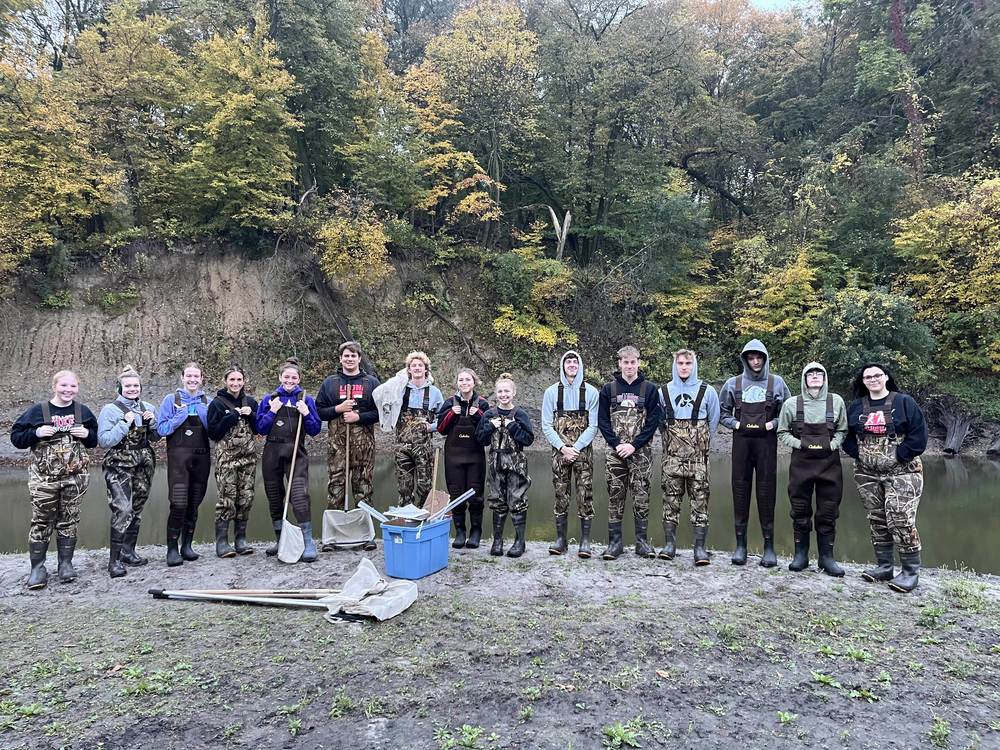
On October 16, 2025, advanced biology students performed water testing assessments on the East Fork of the Des Moines River. The students of Algona High School did four water assessments: physical, biological, stream habitat, and chemical.
In the physical assessment, Tate Carter, Max Tiili, Summer Thompson, and Randi Duehr determined the physical properties, such as air temperature, water temperature, velocity, transparency, and shallowest, deepest, and average depth of the river. The students recorded the temperature using a thermometer. They used a meter stick to measure the bottom of the river. Students measured the velocity with a tennis ball with a string until it was tight. Lastly, the students used a secchi tube to figure out the transparency.
In the biological assessment, Colin Roberts, Macy Knapp, William Parcel, and Gavin Weber worked to figure out the quality of life in the river. They were looking for benthic macroinvertebrates, vertebrates, the algae quality, and the overall plant life on the streambed. The students used nets to stir up the water to see what was on the bottom. They discovered a wild variety of organisms in the river. The last procedure they did was observing the amount of algae and aquatic plants in the river. Since it was raining earlier that morning and the temperature dropped, they ended up not seeing much algae and little aquatic plants.
In the stream habitat assessment, Will Weichert, Avery Hersom, and Audrina Yokimishyn, when they first got there, started looking for stream habitat type, streambed substrate, microhabitats, stream banks, canopy cover, riparian zone plant cover, adjacent land use, and human activity. First they found out the stream type was a raffle. The streambed substrate was 50% cobble, 10% percent was gravel, 20% was sand, and 15% was mud/silt. Later the students found many microhabitats like algae mats, logjams, fallen trees, rocks, and overhanging vegetation. Where the students were located, they were on an eroding bank. Lastly, the students went on to see not much human activity, with a lot of timber that covered 75% riparian zone.
In the chemical assessment, Natalee Reemstma, Charli Dodds, Isis Mendoza, and Tyler Bradley were tasked to test chemical levels including pH, dissolved oxygen, phosphate, nitrate, and chloride. The pH was approximately 7.4 with the Dissolved Oxygen being 9. The students did two tests on the nitrate; first they got 10ppm and second being 0ppm. Next they did the phosphate test, where they found lower numbers, around 0.1. Lastly the students did the chloride test, finding a value around 32mg/I above typical ranges.
Tate Carter said, “It was a lot of fun learning about the river and the different organisms in the river.”