
Written by Alex Brooks
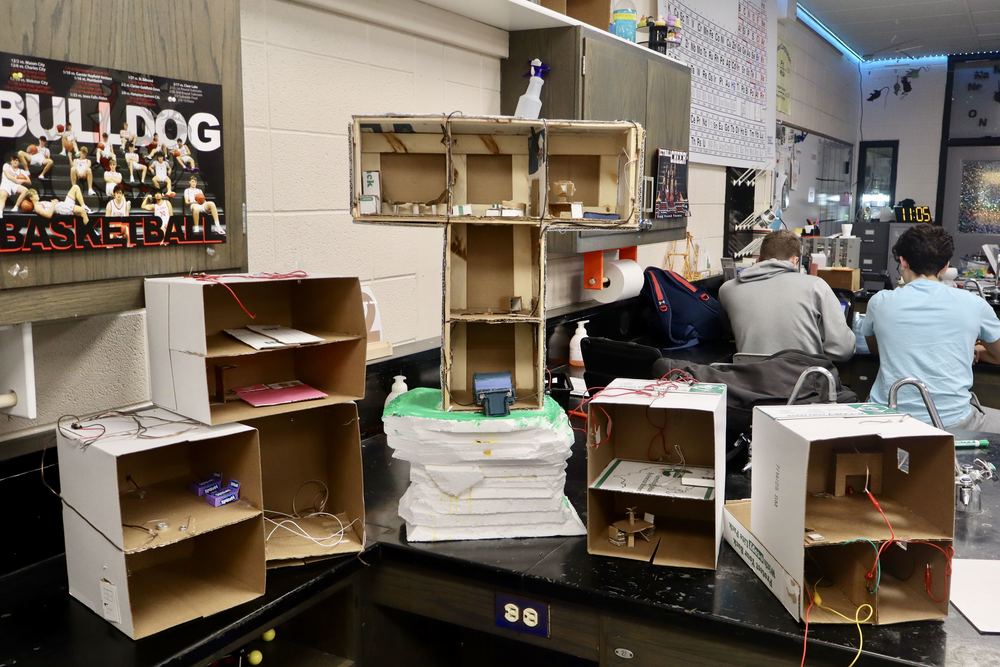
Mr. Stein’s physics class conducted a “lit house” experiment in which students built differently shaped houses to explore how light and energy move. In addition to investigating how light travels, students designed electrical circuits to power lights inside their houses. These included both series and parallel circuits, along with switches that allowed each room’s light to be controlled separately.
Students were able to design their houses in different ways. Some used light-colored interior surfaces, which reflected more light and made the house brighter. Others used darker materials, such as cardboard, which absorbed more light. The shape of the house also affected how light spread. Taller houses concentrated light in certain areas, making it easier to direct downward, while wider houses allowed light to spread out more.
The electrical circuits also played an important role. In a series circuit, multiple lights were connected along one path, so if one bulb went out, all of the lights turned off. In a parallel circuit, each light had its own path, allowing the others to stay lit even if one bulb failed. Switches were used to control each light independently, especially in the parallel setup.
The most effective house design included bright interior walls to reflect light and well-planned circuits. Parallel circuits with switches were especially useful because they allowed each light to function independently. Series circuits could still be used in situations where a single path was appropriate. An outdoor light was also wired in parallel with its own switch, allowing it to operate separately from the rest of the system.
This experiment connects to real-world applications. Houses use similar ideas through features like large windows, skylights, and solar tubes to increase natural lighting. Electrical circuits and switches are also used to control lighting efficiently. Overall, both light reflection and circuit design are important in creating effective and energy-efficient lighting systems.
Students in the class, including Thomas Espe, actively participated in designing and testing their models. Espe shared his thoughts on the project, saying it was “the most fun lab I’ve done in school.”