
Safety Matters at Algona CSD
Strengthening its commitment to student safety, the Algona Community School District (ACSD) has officially launched a formal partnership with the Algona Police Department to introduce a dedicated School Resource Officer (SRO). Officer Ben Gatton, who assumed the role this fall, has already become a vital fixture within the district. Beyond his daily presence, Officer Gatton is actively enhancing campus security through proactive site assessments and hands-on student engagement. Most recently, he spearheaded the implementation of "Stop the Bleed" and "ALICE" training programs, equipping students and staff with the critical skills and confidence necessary for emergency preparedness.
Stop the Bleed
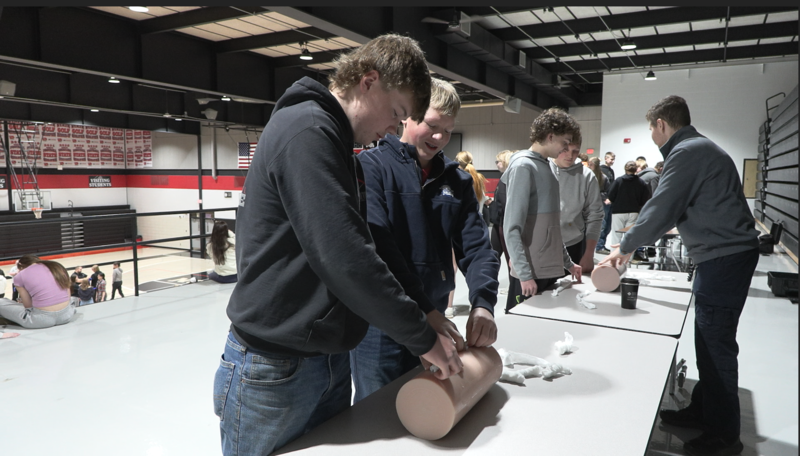 Picture: AHS students participating in "Stop the Bleed" Training
In Iowa, Stop the Bleed training has moved from a recommended safety initiative to a core component of school emergency preparedness. As of 2026, many Iowa school districts have integrated this training into their annual safety protocols to comply with evolving state safety standards and the Department of Education's emphasis on high-quality Emergency Operations Plans (EOPs).
The students at AHS participated in the training, which is designed for non-medical personnel (teachers, coaches, and students) and focuses on three primary actions:
Pressure- Using hands or cloth to apply firm, steady pressure directly to the wound.
Packing- Filling deep wounds with gauze or cloth to stop bleeding from the source.
Tourniquet- Using a specialized device to stop blood flow to a limb if pressure/packing fails.
ALICE Training
In Iowa, ALICE (Alert, Lockdown, Inform, Counter, Evacuate) has become the standard for school safety, replacing the older, passive "hide and hope" lockdown models. As of 2026, Iowa law and Department of Education guidelines emphasize options-based training, meaning students and staff are taught to make active decisions based on where a threat is located.
ALICE is not a linear checklist (you don't have to do 'A' before 'L'). Instead, it is a set of tools students can use in any order:
Alert- Recognizing the danger. Students are taught to listen for PA announcements, gunshots, or screaming, and to trust their gut if something feels wrong.
Lockdown- If you can't get out, secure the room. In Iowa, this now involves barricading—using desks, chairs, and belts to block doors—rather than just locking them.
Inform- Communication. Students and staff use technology (intercoms, apps) to share the intruder's location in real-time so others can make better decisions.
Counter- Last Resort Only. This is not "fighting." For older students, it means creating "chaos" (noise, movement, throwing objects) to distract an intruder's aim so people can escape.
Evacuate- The preferred goal. If a student knows the intruder is on the other side of the building, they are encouraged to run to a pre-designated "rally point" or safe location.
To ensure the training was accessible and effective for all ages, Officer Gatton delivered a tiered, age-appropriate curriculum across the district. Elementary students were introduced to safety concepts through the trauma-informed storybook ‘I’m Not Scared…I’m Prepared’ by notable children’s author Julia Cook. For grades 5–12, the training shifted to a presentation developed by Navigate360, the national leader in ALICE safety protocols. This partnership with Navigate360 provides Algona schools with access to the same premier, standardized safety materials used by leading districts and organizations nationwide.
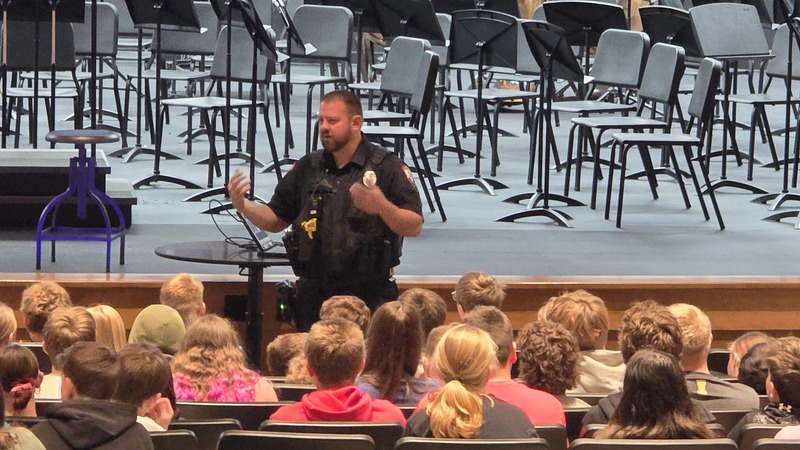 Picture: Officer Gatton giving the ALICE presentation to AMS students
Through these comprehensive initiatives, the Algona Community School District continues to prioritize the safety and well-being of its students and staff. By combining the expertise of the Algona Police Department with nationally recognized training standards, the district is ensuring that its schools are not only secure but that every individual is empowered with the knowledge to act decisively in an emergency. This proactive partnership marks a significant milestone in Algona’s ongoing commitment to fostering a safe, prepared, and resilient learning environment.